Friday, 24 April 2015

Column 11, 2015 – Fit for purpose

Printed in The Cricket Paper, issue 114, Friday April 24, 2015.
[Full text below]


There was a time, really not very long ago, when professional cricketers neither pounded treadmills nor pumped iron.

They got to be professional cricketers because they were really good at cricket, and if they wanted to subsist on three bacon sandwiches and 40 Marlboro Lights a day, it was nobody’s business but theirs.

The stars of the past, from the prominent tobacco endorsements of the Compton era, through the legendary partying credentials of Botham’s, saw the projection of a healthy lifestyle as something for the less gifted to worry about.

The modern cricketer is not just fit, he is conditioned, strong, and has a diet containing lots of protein, quinoa and kale, not many chips and very few kebabs.

Have you seen Chris Tremlet up close? He’s a seriously imposing figure. He may look like he’s got one of those fancy-dress superman costumes with the foam pecs and six pack, but just like his doppelganger Arnold Schwarzenegger, that stuff is actually there. The irony is that those cartoon biceps appear if anything to have slowed down his bowling.

The gym time has not hindered Chris Gayle though, who with his shirt off also looks like a Venice Beach workout freak, but those muscles are very much in evidence as he wields that 3lb railway sleeper to such devastating effect.

Samit Patel, a cricketer of great talent and promise, is probably the most high profile to have had his stop-start international career derailed for carrying a few extra pounds rather than bench pressing them. Which, if you ignore the talent and promise and the international career, is something most of us can relate to.

We had our first game at the weekend in crisp spring sunshine, and I made an overdue 50. The fluffy green outfield was slow, and well over half of it came in singles.

There are 80 lots of 22 yards in a mile, and along with all the non-striker ones and twos, I reckon I probably got there – which, not coincidentally, is almost exactly a mile more than I’ve run since September. It wasn’t warm, but by halfway through I was sweating like a dodgy bookie being interviewed by the Anti Corruption Unit. In the forties, my legs took on the qualities of under-inflated balloons.

Sat here at my desk now, I’m fine. But only because I’m not moving. I just got up to make coffee, and by the time I got back with it, it was cold. Everything aches.

Since the retirement of Inzamam-ul-Haq, the international game has sadly lacked the kind of insouciant stylist who appears motivated to deal chiefly in boundaries through a deep antipathy for the very idea of running.

Some would say, and I would be one of them, that obsessional fitness fascism has robbed the modern game of its more colourful, less identikit characters. But it does have its advantages.

Just as soon as I can walk properly again, I’m off for a run.


- ends 493 words -


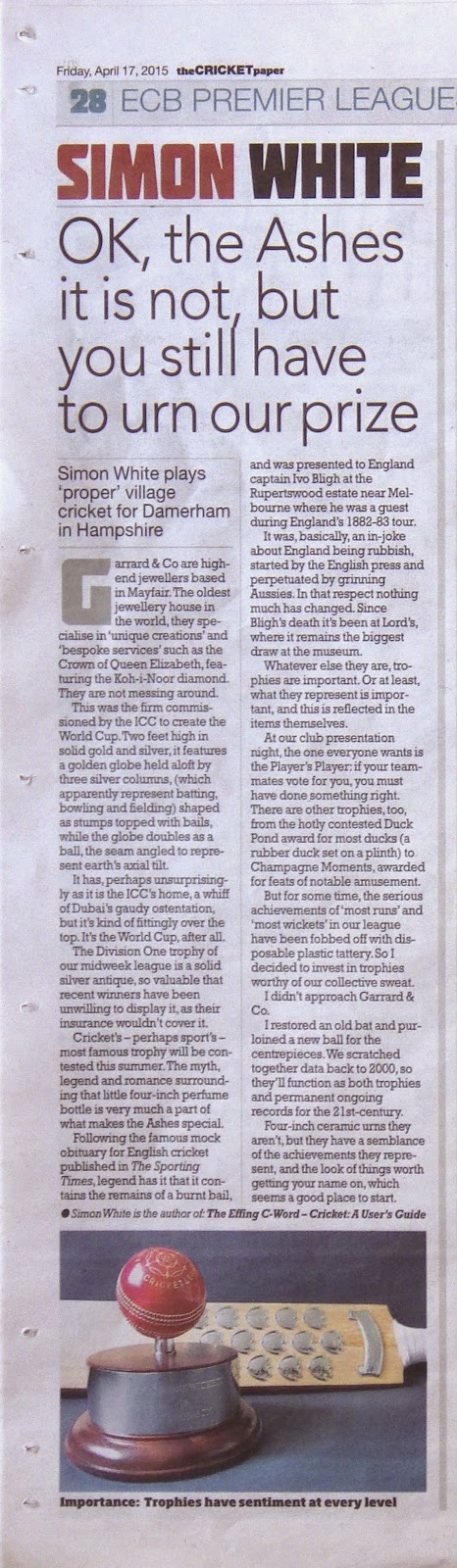
Friday, 17 April 2015

Column 10, 2015 – Eyes on the prize

Printed in The Cricket Paper, issue 113, Friday April 17, 2015.
[Full text below]


Garrard & Co are high-end jewellers based in Mayfair. The oldest jewellery house in the world, they specialise in ‘unique creations’ and ‘bespoke services’ such as the Crown of Queen Elizabeth, featuring the Koh-i-Noor diamond. They are not messing around.

This was the firm commissioned by the ICC to create the World Cup. Two feet high in solid gold and silver, it features a golden globe held aloft by three silver columns, (which apparently represent batting, bowling and fielding,) shaped as stumps topped with bails, while the globe doubles as a ball, the seam angled to represent earth’s axial tilt.

It has, perhaps unsurprisingly as it is the ICC’s new home, a whiff of Dubai’s gaudy ostentation about it, but it’s kind of fittingly over the top. It is the World Cup, after all.

The Division One trophy of our midweek league is a solid silver antique, so valuable that recent winners have been unwilling to display it, as their insurance wouldn’t cover it.

Cricket’s – perhaps sport’s – most famous trophy will be contested again this summer. The myth, legend and romance surrounding that little four-inch perfume bottle is very much a part of what makes The Ashes special.

Following the famous mock obituary for English cricket published in The Sporting Times the previous summer, legend has it that it contains the remains of a burnt bail, and was presented to England captain Ivo Bligh at the Rupertswood estate near Melbourne where he was a guest during England’s 1882-83 tour of Australia. It was, basically, an in-joke about England being rubbish, started by the English press and perpetuated by grinning Aussies. In that respect nothing much has changed. Since Bligh’s death it’s been at Lord’s, where it remains the biggest draw at the museum.

Whatever else they are, trophies are important. Or at least, what they represent is important, and this is reflected in the items themselves.

At our club presentation night, the one everyone wants is the Player’s Player. If your teammates vote for you, you know you’ve done all right. There are other trophies too, from the hotly contested Duck Pond award for most ducks (a rubber duck set on a plinth) to Champagne Moments, usually awarded for feats of notable amusement.

But for some time now, the serious achievements of ‘most runs’ and ‘most wickets’ in our league season have been fobbed off with disposable plastic tattery. So I decided to invest in some trophies worthy of our collective sweat.

I did not approach Garrard & Co.

Instead, I restored an old bat and purloined a new ball to form the centrepieces. With a bit of digging we scratched together data back to 2000, so they’ll function as both trophies and permanent ongoing records for the twenty-first century.


Four-inch ceramic urns they are not, but they have a semblance of the achievements they represent, and the look of things worth getting your name on, which seems a good place to start.


- ends 493 words -


Friday, 10 April 2015

Column 9, 2015 – Administration balls up

Printed in The Cricket Paper, issue 112, Friday April 10, 2015.
[Full text below]


For most of us, cricket admin is ‘Who’s going to order the balls?’

Who’s organising friendlies? The scorebook’s nearly full. Someone needs to go to this AGM. Shall we play in a midweek league? Gotta have orange balls for that, right? Who’s getting those? We need new letters for the scoreboard. Who’s gonna sit on this committee? What about organising a rota of people to help with the pitch…

In normal life, I am neither organised nor an organiser, but in a cricket context I (mostly) don’t mind. Especially this time of year, when balls being delivered is part of the build up of excitement to cricket actually happening again.

To me, this is what cricket admin means.

In professional cricket though, administration means something quite different.

We are in a period of extraordinary slapstick in international cricket administration. Not since the golden years of Laurel and Hardy has this kind of high-sheen polish been meticulously applied to every detail of an operation, giving the impression of comical ineptitude so convincing, that you’d be forgiven for thinking that they really are as utterly clueless as they’ve contrived to look.

ICC president Mustafa Kamal resigned last Wednesday in what can only reasonably be described as a huff, ostensibly because ICC chairman N. Srinivasan presented the World Cup to Australia, not him, as was his constitutional right as president.

Kamal, fresh from a wincingly inappropriate attack on his organisation’s own umpires following a disputed World Cup decision, resigned saying “I can’t work with those who act unconstitutionally and unlawfully.” Apparently without irony, he went on: “These type of people should be away from cricket, otherwise cricket will be spoilt.”

The ICC then brilliantly issued a press release stating that “Mr Kamal said that he was stepping down on personal grounds and offered his apologies to all associated with the ICC, while adding that he had no complaints to make against anyone.”

In Kamal’s defence, (and boy does he need one,) Srinivasan is a comedy villain to put Boss Hogg to shame. He’s implicated in so many scams and corruption scandals that it’s very difficult to keep up. As BCCI president, he conducted an investigation into match fixing at Chennai Super Kings, the IPL franchise owned by India Cements, which he owns, and run by his son-in-law, who was the one arrested. This blatant conflict of interest prompted the Supreme Court of India to order his resignation from the BCCI, pronouncing it “nauseating” that he was still in office.

It was more or less at this point, with (I think, though as I say it’s hard to keep up) only three major corruption cases pending against him, that England and Australia thought it best to elect him chairman of the ICC.

Meanwhile, with all this going on, who has ordered this season’s balls? Or have they been ordered, but just not turned up yet because they’re on back-order? These are the perennially burning cricket admin questions.


- ends 493 words -


Friday, 3 April 2015

Column 8, 2015 – Backing the Blackcaps

Printed in The Cricket Paper, issue 111, Friday April 3, 2015.
[Full text below]


I shouldn’t have bet on New Zealand. I don’t bet much, but World Cups are an exception. I made a couple of quid when the Windies won the WT20 in 2012. I didn’t on England in 2010 – a wise old gambler once told me: if you care about it, don’t bet on it.

New Zealand vs Australia was the best game of the tournament. No, not Sunday’s one-sided anticlimax, the group game back in February. It had everything. Attacking and defensive batting, tremendous swing and spin bowling, tension, drama, 19 wickets and a knife-edge climax. All in 55.3 overs. To cap it all, the good guys won. The perfect ODI.

I’ve watched it four times already. Most recently with my 12-year-old nephew, who didn’t know the result.

A right arm seamer with a naturally fluid action, Jude is probably already a better cricketer than me. If he’s not now, he will be soon. He’s been training with district coaches this winter, and if he keeps playing as he gets bigger and stronger, he’s going to be a very decent quick.

He is, self-confessedly, a less gifted bat. We had a great discussion last weekend about number 11s, and just how crucial a nought-not-out can be to keep an innings alive, so the guy up the other end can get the runs. Then we settled down to watch Milne and Southee’s ducks to spearing Starc yorkers, and Boult (the number 11 whose 5-27 had surely earned him the right to put his feet up) survive the rest of the over so that Williamson, the number three stranded up the other end, could hit the majestic, nerveless straight six that won the game.

Boult is at the heart of my favourite World Cup story, from the New Zealand Herald. His girlfriend is a pretty 24-year-old blonde called Gert Smith. (Her real name is Alexandra, Gert is a family nickname because her younger brother couldn’t say Alexandra. You like her already, don’t you?) Gert is a primary school teacher in Tauranga, on the Bay of Plenty. Since her charges have discovered that ‘Miss’ is going out with a national sporting hero, she’s been bribing them. They get tokens for good behaviour, and she’s promised that if they get to a hundred, Boult will come and visit the class.

New Zealand nailed this World Cup. The way they played, the way they were led, the way they behaved.

They had obvious respect for their opponents, even as they went at them as hard as they could. Relentlessly aggressive, they were never less than friendly. Committed and unified, they did not gloat or goad, send-off or sledge. They played with character, won with humility, lost with grace.

Unimpeachable role models for primary kids in Tauranga, 12-year-olds in England, and doubtless thousands more across New Zealand, they were terrific to watch.

I should not have bet on them because, the more I watched them, the more I cared that they won.

Congratulations Australia. Dammit.


- ends 498 words -


Friday, 27 March 2015

Column 7, 2015 – Bowling in a rigged game

Printed in The Cricket Paper, issue 110, Friday March 27, 2015.
[Full text below]


One of the game’s favourite clichés has recently been pulled from the dusty recesses of the pavilion to have the cobwebs brushed off it once again. It remains as true today as it ever was: the balance between bat and ball.

The recurring critique this month has been that the ODI playing conditions have tipped too far in favour of the bat. The three usual suspects hauled up to face the punditry committee are: “bats these days”; the rule change allowing only four fielders outside the circle; and a new ball from both ends.

The ongoing “bats these days” brouhaha deserves a column of its own, so let’s come back to that later. The other two are hard to argue with.

The four-men-out experiment has made the whole concept of defence, especially at the death, almost redundant. So much so, that even the ICC may have noticed, and there’s a reasonable chance we’ll see it revert back to five after the World Cup.

I’d love to see a return to the solitary ball, and with it the potential for fun stuff like sharp spin and reverse swing, but as it’s apparently beyond the wit of man to make a white ball that stays white for 50 overs, we’re probably stuck with two.

So as it stands the balance does seem skewed. All the more remarkable then, that despite the game being rigged against them, the cream of the world’s fast bowlers have put on quite a show.

Two thirds of Australia’s Mitchell triumvirate, Marsh and Johnson, have been quiet, but Starc has been excellent, as fine an exponent as you’ll see of the blisteringly fast late swinging yorker. New Zealand’s new ball (each) pair of Southee and Boult have also been exceptional. But for me it was two subcontinental quicks who have so far provided the best edge-of-the-seat moments.

The top “Hello, here comes the upset!” contender came courtesy of the tournament’s surprise package, the 90 mph Bangladeshi quick with cheekbones you could open letters with, Rubel Hossain. Fresh from gleefully sealing England’s early fate, when he tempted Kholi into a waft outside off-stump in the quarter-final against India, those Douglas Fairbanks matinee idol features were transformed by a primal war cry and, just for a moment, it all looked possible.

There was one spell though, that will outlive the tournament, just as the Donald vs Atherton encounter at Lord’s lives on in the memory, long after the series it was part of has faded. The brutal six over assault from Wahib Riaz in Pakistan’s quarter-final against Australia rendered such trifles as two new balls and four-men-out utterly irrelevant. The working-over he gave Watson was so comprehensive, so masterful, delivered with such tightly reined ferocity, that for those 20 minutes, the balance did indeed look skewed – the other way.

But then Rahat Ali shelled the hard-won top edge, the moment passed, the spell was broken, and the bat was back on top.


- ends 492 words -


Friday, 20 March 2015

Column 6, 2015 – The Triangle of Adequacy™

Printed in The Cricket Paper, issue 109, Friday March 20, 2015.
[Full text below]


After nets last week, over the couple of post-exercise pints we consider to be integral to ‘winter training’, Clive and I alighted on a surprisingly robust theory.

There is something about sitting in a fire-warmed winter pub in a slightly sweaty tracksuit that is conducive to such philosophical breakthroughs. Or maybe it’s just us.

It stemmed from how tricky it is to get people to come to winter nets. Whatever you organise – midweek, weekend, early, late, bowling machines or regular queue-up-and-bowl – the one thing you can be absolutely sure of is that fewer people will turn up than you’d hoped.

This led us to lament gloomily how generally unfair it is that some people don’t even need to bother practicing to be any good.

Now, this is a well worn path. Commonwealth table tennis champion turned sportswriter Matthew Syed wrote a fascinating book about it called ‘Bounce’.

There’s a popular theory called the 10,000 hours rule, which – and I’m heavily paraphrasing here – says that 10,000 hours of practice makes you a master. At batting, chess, piano, painting, maths, tiddlywinks. Anything.

Two other books that touch on it are Malcolm Gladwell’s ‘Outliers’, and David Epstein’s ‘The Sports Gene’ which expound the theory first put forward by a guy called Anders Ericsson in 1993.

They all pretty much disagree on the baseline though. Epstein, as his title suggests, thinks natural talent is an essential ingredient, Ericsson more or less rejects the concept of talent, and Gladwell is somewhere inbetween.

The lightbulb Clive and I had was not about 10,000 hours (which we’re a bit long in the tooth for) but a unified theory of the nature/nurture argument, and the balancing mechanism for what we concluded must be the three key ingredients.

These ingredients are: talent (ability, gift, aptitude), skill (acquired proficiency, experience, learned techniques), and work (practice, application, effort, hard yards).

Over the second pint, we christened this mighty triumvirate “the Triangle of Adequacy”.

Everyone’s triangle is a different size and shape. The baseline – talent – doesn’t move. You’re born with it. Work can increase your skill levels, but the more talent you had to begin with, the less work is needed to up those skill levels: those with limited ability must work much harder than the talented to achieve similar results. The harsh reality is, the gifted grafter is uncatchable.

Now, the cynical might argue that the triangle doesn’t make nebulous quantities like talent and skill any more knowable, and can only ever be hypothetical. But I think the combination of fairy tale anyone-can-do-anything optimism and Dirty Harry ‘A man’s got to know his limitations’ realism is potentially quite useful.

Basically, once you’re familiar with it, your own Triangle of Adequacy™ can tell you whether it’s worth putting in a few extra hours with the bowling machine, or whether you might as well skip it this week, save it for the season, and go straight to the pub.


- ends 486 words -


Friday, 13 March 2015

Column 5, 2015 – stats and creativity

Printed in The Cricket Paper, issue 108, Friday March 13, 2015.
[Full text below]


99.94. If you’re interested in cricket, you’ll know that figure, and the extraordinary achievement it represents. The batting average of Sir Donald Bradman is statistical royalty, up there in gold lettering on the metaphorical all-time honours board with Sachin Tendulkar’s hundred international hundreds.

Cricket loves stats. Tournament sixes, batting average, bowling average, economy rate, strike rate, run rate, highest this, fastest that. We love it all.

Barely a week passes without more statty fun. Last weekend Glenn Maxwell missed Kevin O’Brien’s fastest World Cup 100 by two balls, and Kumar Sangakara became only the second man in history to pass 14,000 ODI runs.

Cricket is just so measurable, it’s always been stat obsessed. The stats tell us what’s normal, what’s exceptional, what to aspire to.

Recently, much has been made of England’s turn towards data’s dark side. Under Moores and Flower, England put 100% of their eggs in the algorithmic basket.

When he was his boss the first time around, Moores gave Flower a copy of the 2003 book ‘Moneyball’, the story of Oakland Athletics baseball team and its manager Billy Beane (Brad Pitt in the Hollywood version) who used rigorous statistical examination of in-game plays and situations in order to base decisions on predictive data extrapolated from the computer analysis of historical likelihoods.

Did you enjoy that last paragraph? Welcome to the England dressing room.

After initial success, the long-term problem with this approach is that it stifles creativity. Modern cricket is increasingly creative and inventive. International batsmen must score quickly and powerfully all round the ground, bowlers need an armoury of unpredictable variations. The gameplans of De Villiers, Maxwell, Faulkner and Boult are not based on statistical analyses of the past – they’re inventing the new paradigm.

Try for a moment, just for fun, to imagine it’s your job to convince McCullum not to be aggressive between overs 10 and 35, because that’s when the MOST important thing is not losing wickets. Well, that’s what the stats say, Brendon.

In advertising, creativity is often steamrollered by research. If you let it, inoffensive banality will always trump inventiveness in the quest for the sale. It’s all about sales, that’s the measure. Be safe, do what works, trust the numbers. Apply that to cricket: do what works, what you must to win. Trust the numbers. Forget everything else. Winning is how we’re measured. Nothing else matters.

In both instances, the thinking is poisonous. If you look beyond the numbers at how the best really succeed, the answers are there. Flair, style, chutzpah, flexibility, the courage of your convictions – simple bottle. Get that happening, and the results will come.

Fun is a prerequisite for creativity. An ad-land pioneer once famously said that advertising is the most fun you can have with your clothes on. I would happily apply that adage to cricket. But England this winter didn’t look like they were having much fun. And, let’s be honest, 99.94% of the time, watching them hasn’t been either.


- ends 495 words -